
Policy in Practice: Good Samaritan Law & The Promise of Cashless Trauma Care
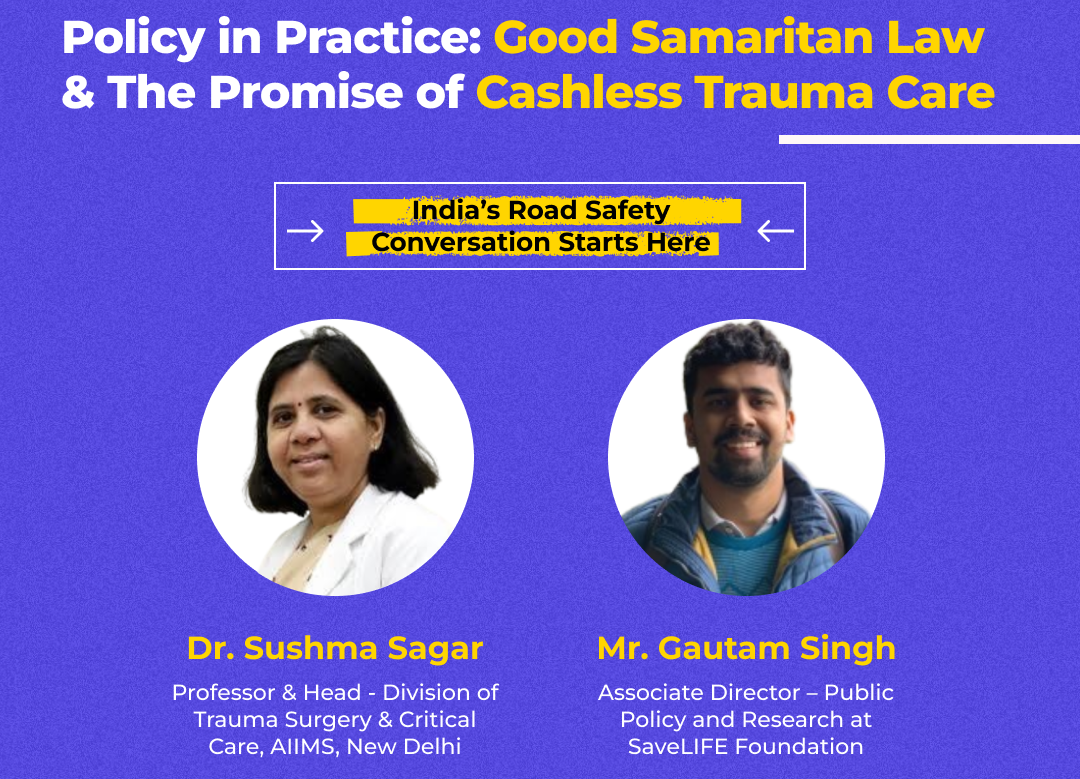
Our inaugural webinar brought together experts to discuss the Cashless Treatment Scheme for Road Accident Victims 2025 and the on-ground state of Good Samaritan protections.
What the 2025 scheme says
The Cashless Treatment Scheme for Road Accident Victims, 2025, mandates that empanelled hospitals provide free trauma care up to a defined ceiling for victims of motor vehicle crashes. Costs are reimbursed centrally — the victim's family pays nothing at the point of care.
The headline: ₹1.5 lakh of free emergency care for up to seven days at any empanelled hospital. Hosted on 27 July 2025 with Dr. Sushma Sagar (AIIMS Delhi) and Mr. Gautam Singh (SaveLIFE Foundation), the panel called India's road deaths a "silent genocide" — one Indian dies on the road every 10 minutes, mostly young two-wheeler riders and pedestrians.
Good Samaritan reality check
Indian law protects bystanders who help road crash victims — from being detained, harassed or required to bear hospital costs. Yet bystander hesitation remains the single largest reason victims do not reach a hospital in time.
“The law is no longer the bottleneck. Awareness is.”
“What stops people is not the law, it's fear and lack of clarity.”
The panel proposed a "chain reaction" strategy: if every person who learns about the Good Samaritan Law explains it to three more, awareness can scale faster than any government campaign.
e-DAR & data that saves lives
India's Electronic Detailed Accident Report (e-DAR) system enables real-time, geotagged crash reporting by police into a unified national database. The panel highlighted how e-DAR is already being used to:
- Identify accident hotspotsCluster analysis at the corridor and junction level.
- Deploy targeted calmingSpeed management, signage and geometric fixes where they matter most.
- Plan trauma-care resourcesWhere to position ambulances and Level-1 trauma capacity.
A national trauma care system
Both speakers stressed that trauma care begins at the crash site, not at the hospital gate. India's "chain of survival" is fragmented: multiple emergency numbers (108, 112, 100), too few trained paramedics, and uneven trauma units across states. Their recommendations:
- A single nationwide emergency numberEnd the confusion between 108 / 112 / 100.
- Standardised pre-hospital protocolsCommon triage and stabilisation training.
- Dedicated trauma units in every hospitalNot just metro Level-1 centres.
- Greater civic and tech-sector engagementApps for verification, claims and fraud prevention.
Where implementation breaks
- Hospital readinessMany empanelled hospitals have not trained intake staff on the new protocol.
- Police awarenessFirst officers on scene sometimes still discourage bystander involvement.
- Citizen confidencePublic messaging on rights is thin in regional languages.
Three asks for the year ahead
- Train every PHCA standardised intake script for cashless trauma care.
- Statewide mediaRegional-language campaigns explaining bystander rights.
- Live dashboardsPublic reporting on cashless scheme uptake by district.
Carry these rights with you
If you witness a crash, you are protected by law. If you are injured, you have a right to immediate care.
Share this story
An expert webinar on India's evolving post-crash care and Good Samaritan framework.