
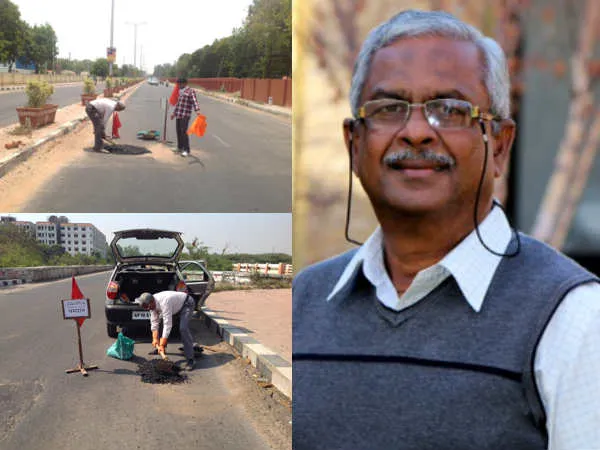
Gangadhara Tilak Katnam: The Pothole Man of Hyderabad
Most people complain about potholes. A few tweet about them. Almost no one fixes them. Gangadhara Tilak Katnam did.
In 2011, a 65-year-old software engineer hit a pothole so hard that he stopped to watch a school bus nearly lose control behind him. That moment changed everything. Gangadhara Tilak Katnam quit his job, turned his car into a mobile repair unit, and spent ₹20+ lakh of his own money filling over 2,000 potholes across Hyderabad — proving that infrastructure doesn't fail because India lacks money, it fails because no one owns the last mile.
Where it Actually Started
In 2011, Gangadhara Tilak Katnam was 65, working as a software engineer at MMTS (Multi-Modal Transport System).
On a routine drive to work, his car hit a pothole so violently that he stopped immediately. A school bus behind him swerved and almost lost balance. That close call pushed a blunt realisation:
There was no "campaign plan," no blueprint. Just irritation turning into responsibility.
The First Repair
He simply bought cold mix asphalt, put it in the car, and filled one pothole near Madhapur.
That one repair became two. Two became ten. And in six months, fixing potholes became his full-time routine.
He Quit His Job to Fix Roads
In 2012, he resigned from his engineering job so he could dedicate his time fully to road repairs. Not many people quit white-collar careers to do manual work on boiling hot highways. He did. He turned his Maruti 800 into a mobile repair unit — cement bags, gravel, asphalt mix, iron rods, water. Everything. Paid from his pension and savings.
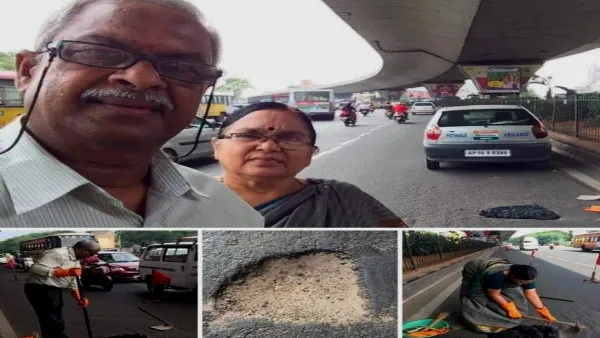
Numbers That Aren't Guesswork
These are hard verified numbers from government and media records:
These numbers aren't inflated — these are what Hyderabad civic officials themselves endorsed.
Shramadaan: When His Work Became a Movement
In 2013, after multiple media reports, strangers started calling him and asking:
"There's a pothole near my lane — will you fix it?"
He realised doing it alone won't scale.
So he founded Shramadaan — a citizen-driven volunteer movement.
The idea was insanely simple:
By 2014, Greater Hyderabad Municipal Corporation (GHMC) formally collaborated with him so they could respond faster and use his reporting network.
The Government Actually Ended Up Learning from Him
Katnam's fixes were faster, cheaper, and more reliable than theirs.
He proved:
- Potholes don't need three layers of files.
- They don't need tender processes.
- They don't need six inspections.
- They just need someone who gives a damn and knows basic engineering logic.
Why His Work Is More Than Feel-Good Content
India recorded 3,625 pothole-related deaths in 2022 (MoRTH).
That number is embarrassing for a country that builds world-class expressways yet fails at maintaining basic urban roads.
Katnam's work is proof of something uncomfortable:
One retiree with a bag of asphalt solved a problem entire departments took years to even acknowledge.
Awards and Recognition (All Verified)
- CNN-IBN Real Heroes Award (2014)
- Karmaveer Chakra Award
- Appreciation from GHMC & Telangana Government
- Featured in multiple national media outlets including NDTV, The Hindu, Times of India.
He rejected the "activist" tag repeatedly. He preferred one word: citizen.
What He Proved
- You don't need authority to improve a city.
- You don't need a camera crew to do impactful work.
- You don't need a title to save lives — you need intent.
- And intent is what India lacks the most.
His Legacy
Katnam stopped counting potholes after 1,000.
Not because he wanted to hide numbers — he simply didn't care about the scoreboard.
He cared about preventing crashes.
Own the Last Mile
Katnam didn't wait for a budget, a tender or a title. He showed that the difference between a death-trap road and a safe one is usually one citizen who refuses to look away.
- Report potholes to your local civic body
- Don't normalise broken roads as 'just how it is'
- Support citizen-led infrastructure movements
Heroism isn't glamorous. It's repetitive, inconvenient, dirty work — done by someone who refuses to look away.
Have a story to share?
If you know an unsung road safety hero, or have a story from the road, we’d love to hear from you.
Get in touchShare this story
One retiree quit his job to fix 2,000+ potholes and changed how Hyderabad maintains its roads