
A Real-Time Nudge for Safer Roads: Trinity Circle, Bangalore
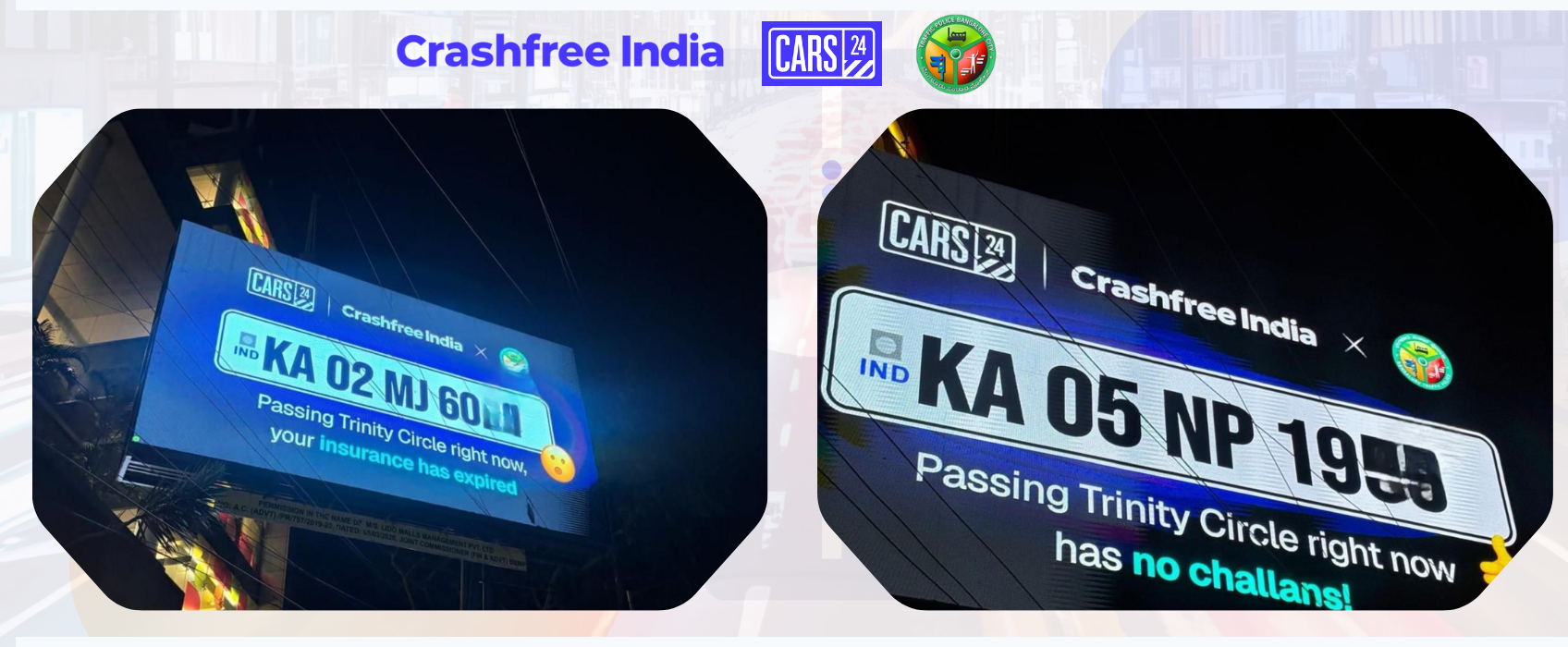
In partnership with Bengaluru Traffic Police and Cars24, a real-time billboard at Trinity Circle reads number plates and surfaces pending challans within seconds.
The idea
Every hour, 20 people die on India's roads. That's not just a statistic — it's a blunt reminder that the system is failing at scale. In 2023 alone, India saw 4,80,583 road crashes and 1,72,890 deaths. Karnataka mirrors this crisis: 43,440 crashes and 12,321 deaths in 2023, translating to 119 crashes and 33 deaths every single day.
Most riders learn about pending challans only at vehicle renewal — years after the violation. The Trinity Circle pilot collapses that gap to seconds. As a vehicle approaches, the billboard reads the plate and surfaces challan status in plain language. The problem is urgent. But the solution is not just punishment — it's feedback, visibility and behaviour change at the very moment people make decisions on the road.
How it works
Together with Bangalore Traffic Police (BTP) and Cars24, Crashfree India piloted something new at one of the city's busiest junctions — a real-time compliance billboard. Here's the loop:
- 1 · ANPR cameras read platesVehicles are detected as they approach the signal.
- 2 · BTP database lookupPulls live challan, PUC and insurance status in seconds.
- 3 · LED billboard surfaces statusWithin seconds, the vehicle's status is shown on a giant LED board at the junction.
- 4 · Instant nudgeIf your papers are in order, the screen acknowledges you. If not, you get an instant reminder.
This isn't about shaming — it's about closing the feedback loop in traffic itself, when choices matter most. A simple public nudge to regularise documents, clear dues and prevent risks linked to serious crashes.
Early signals
Because numbers don't change behaviour — timely, visible feedback does.
“We are not reminding people to clear challans or update documents. We're reminding them that every act of responsibility on the road, no matter how small, is what keeps an entire city alive. Safety doesn't come from systems alone; it comes from choices. And the road is the one place where your choices instantly touch thousands of lives.”
For the Trinity Circle pilot, we'll track three signals:
- On-site complianceShare of vehicles with no pending challans / valid PUC / insurance — the 'green' acknowledgements over time.
- Resolution latencyAggregated, anonymous time from on-screen prompt to challan settlement.
- Risk-behaviour proxiesChange in helmet/seatbelt violations and red-light jumps at and near the junction, via camera analytics + e-challan data.
What it takes to scale
Crashfree India exists to make safety default — by design and by habit. The Trinity Circle pilot is just one layer. In recent months we've also run Project Rakshak (36 teams auditing 50+ high-crash sites), the Policy Ideathon (250+ youth teams), and shipped open tools — a road safety data portal, a community reporting platform and the Safekart device repository.
- Enforcement & complianceExpand real-time boards, integrate payment flows, co-create safety campaigns.
- Engineering fixesCo-fund and implement quick builds at crash hotspots.
- Trauma carePilot protocols, training and faster golden-hour response.
- Open data & researchPublish crash, challan and treatment outcomes for accountability and learning.
The hardware is commodity. The hard part is the data integration — every state RTO–police–transport chain needs an API. Trinity Circle is a proof point. The next 25 cities are a policy question. The road safety crisis is not abstract. It's immediate. It's personal. And it's solvable — if we act together.
Make enforcement visible
Pending challans should not stay invisible until renewal. The Trinity Circle pilot shows a path.
Share this story
A real-time ANPR billboard surfacing pending challans at one of Bengaluru's busiest junctions.