
On the Clock, On Our Roads: The Road Safety Risks of Gig Riders
With India's gig economy set to encompass 23 million workers by 2030, addressing rider safety is no longer optional — it is a public health imperative.
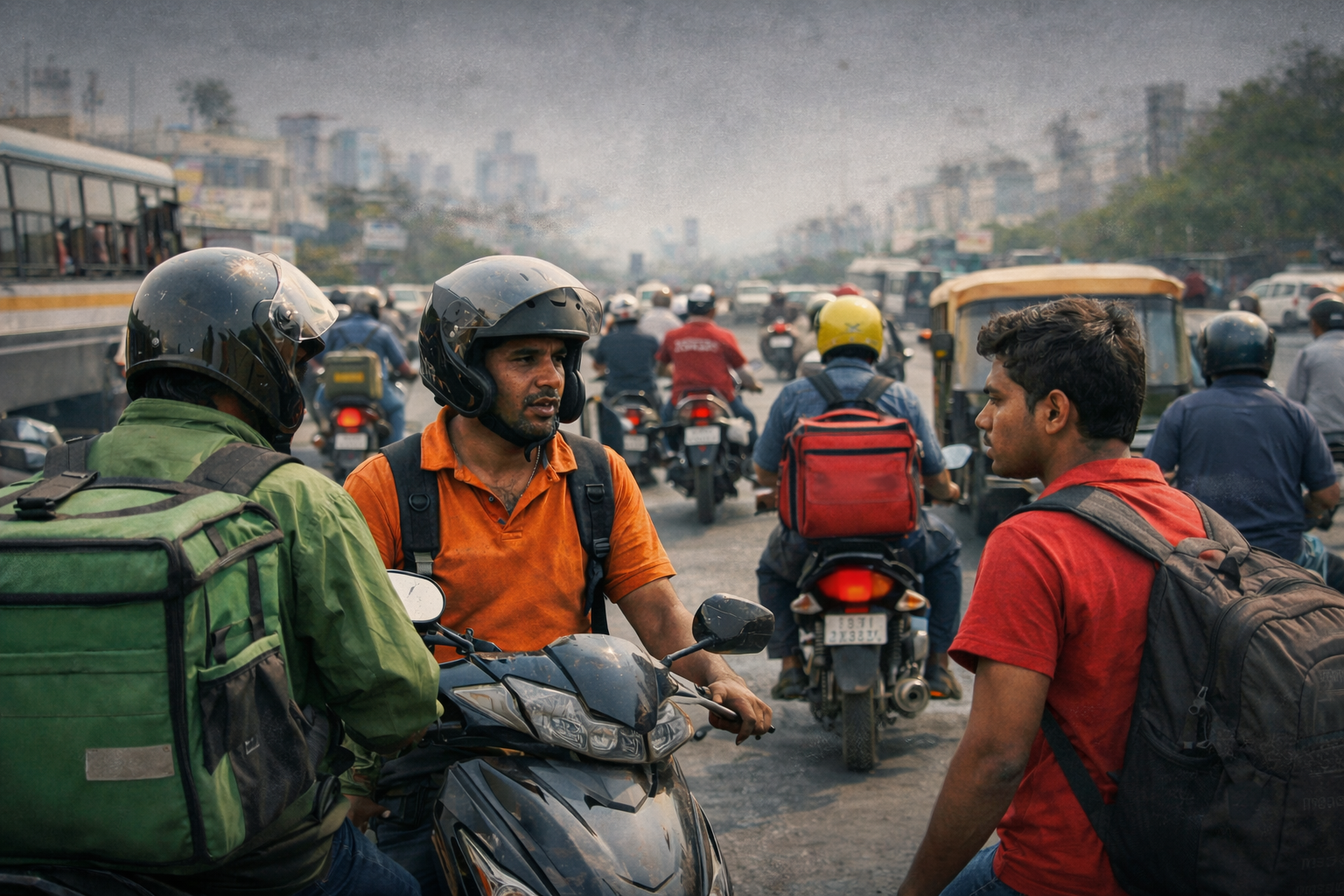
Executive summary
India's gig economy is on track to swell from 7.7 million workers in 2020–21 to roughly 23.5 million by 2030. Every order delivered, every ride hailed, lands on a two-wheeler — the road user most exposed to serious harm. In 2023, two-wheelers accounted for nearly 45% of India's road fatalities. Gig riders sit at the sharpest end of that statistic.
Two wheels, many lives
Two-wheeler deaths in India have climbed steadily — from 20,457 in 2014 to 57,282 in 2023. Pedestrians and cyclists trace a similar grim arc. Behind each statistic sits a household losing a primary earner, often in their twenties or thirties.
The gig rider equation
Quick-commerce platforms promising 10–15 minute delivery have converted speed pressure into a structural risk. Riders chase incentives that scale with order count, on streets that were never engineered for same-day commerce. The result: a workforce where every delivery carries hidden injury risk, and where the cost of a missed SLA is sometimes paid in lives.
Challenge 1 — Structural and occupational risks
- Long hours10–14 hour shifts, often without a meal break or a rest stop.
- Heat and fatigueRiders move through 45°C summers and unlit monsoon nights.
- No safety netSparse insurance, no paid medical leave, weak claim pathways.
Challenge 2 — Operational and behavioural risks
Mumbai traffic data captures the picture starkly. Across one enforcement drive, four food-delivery brands accounted for the bulk of violations issued to gig riders:
Bengaluru enforcement data tells the same story: helmet non-use, no pillion helmet, and wrong-side riding dominate the violation mix — each of them strongly correlated with fatal outcomes for riders.
Challenge 3 — Data scarcity and silos
India still lacks a unified crash dataset that tags gig vs. private rider incidents. Platforms hold the richest behavioural data, but rarely share it. Police FIRs hold legal data, but seldom capture platform identifiers. Without integration, both regulators and researchers operate blind.
Priority Area 1 — Inadequate training
Most gig riders enter platforms with a two-wheeler licence obtained on a short, theory-light test — and an estimated 30% of Indian driving licences are issued without a real road test(per former minister Nitin Gadkari). Platforms then onboard riders via app walkthroughs, not structured road-safety instruction. The result: high-risk behaviours — wrong-side riding, signal jumping, speed-limiter tampering on e-bikes — surface in challan data across Bengaluru, Mumbai and Delhi.
Bengaluru Traffic Police's 2024 crackdown collected ₹30.57 lakh in fines from delivery riders in a single drive, and has since started in-person rider safety training sessions with platforms — the model worth replicating nationally.
Priority Area 2 — Helmet non-compliance
Helmet violations are the single largest traffic offence category in cities like Delhi, where one rider was fined ₹61,000 across five helmet-related challans in 2025. The crisis is sharpest on bike taxis: pillion passengers refuse shared helmets on hygiene grounds, and many riders carry only one ISI-certified helmet — or none.
- ISI is non-negotiableBengaluru Police cannot legally fine non-ISI helmets — only no-helmet riding. The standard must be policed at point of sale, not on the road.
- Two-helmet contractsMake rider and pillion helmets a platform onboarding requirement, audited every quarter against challan data.
- Hygiene-safe disposablesDisposable helmet liners (already standard in Vietnam and Indonesia) solve the bike-taxi pillion problem at scale.
Priority interventions
- Mandatory trainingEvery rider onboarded with a structured road safety module, not a PDF.
- ISI helmet enforcementHelmet checks linked to platform IDs, audited every quarter.
- Realistic SLAsCap delivery windows where infrastructure cannot absorb the speed.
- Open dataAnonymised crash and challan dashboards published city-by-city.
A call to action
India does not need to choose between a thriving gig economy and safer roads. It needs to design for both. Platforms, regulators and citizens can together build a safety stack where speed and survival coexist.
“Riders are not collateral damage in the quick-commerce boom. They are its frontline. Protect them, and the entire road gets safer.”
Build the rider safety stack
Protecting India's gig workforce requires platforms, governments and citizens to act in concert — not in silos.
- Make ISI-certified helmets contract-mandatory for every delivery and ride-hail partner
- Replace 10-minute delivery promises with safer, realistic windows
- Publish anonymised crash and challan data for every aggregator and city
- Fund last-mile infrastructure: rest stops, lighting, and rider-only lanes
Share this story
A research brief on India's gig rider safety crisis — and the policy stack that can fix it.
More Inspiring Stories
Webinar: Last Mile, First Priority — Policy Perspectives on Delivery Rider Safety
Experts on protecting India's delivery workforce — and why 10-minute delivery hides real risk.
From ADAS to ARAS to a Safety Stack: Rethinking Two-Wheeler Safety in India
Why two-wheeler safety in India needs more than rider-assistance technology alone.