
Webinar | Last Mile, First Priority: Policy Perspectives on Delivery Rider Safety
Every '10-minute delivery' carries hidden risk. Our expert panel made the case that protecting riders means redesigning the systems they ride in.
The growing challenge
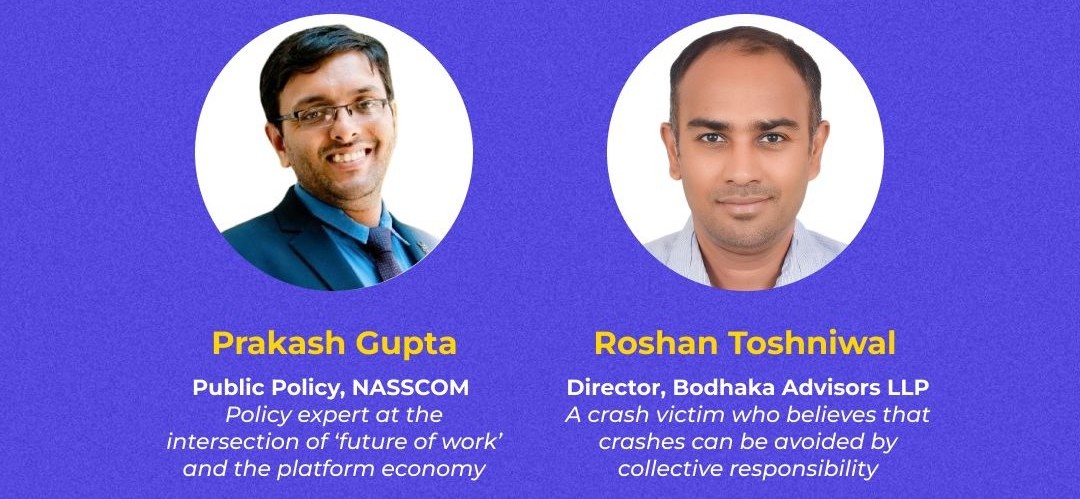
On August 30, 2025, Crashfree India hosted Last Mile, First Priority: Policy Perspectives on Delivery Rider Safety. The idea was simple — riders aren't just gig workers, they're citizens on two wheels. Their safety shapes the safety of everyone on the road. The session brought together our mentors Mr. Roshan Toshniwal and Mr. Prakash Gupta, both guiding teams in the NextMile Road Safety Policy Ideathon, several of which are working on Regulating E-Commerce and Delivery Rider Safety.
- 2020–21India had about 7.7 million delivery riders.
- 2029–30 projectionCould swell to 23.5 million riders (RiderWings).
- Quick-commerce boom10–15 minute deliveries are increasing risk exposure.
- Chennai surveyOver 30% of surveyed riders admitted to accidents (IOSR Journals).
- Risk factorsFatigue, phone distractions, pressure to deliver fast.
India's quick-commerce promise is built on the backs of two-wheeler riders racing 10–15 minute SLAs. Every minute shaved at the platform end becomes a measurable injury risk at the road end.
Key insights from the discussion
- 01 — Riders: visible, vital, vulnerableIndia's quick-commerce boom puts millions on the road every day. Most orders come at night, when fatigue and poor lighting multiply risk.
- 02 — The last-mile infrastructure gapDespite highway investment, last-mile roads remain neglected — unmarked speed breakers, poor lighting, no rest stops.
- 03 — Behavioural norms need systemsMost riders begin without formal safety training. Safety must be built into contracts, not left as an afterthought — insurance, rest time, welfare benefits, claim mechanisms — and portable across states via e-Shram.
- 04 — Rebalance speed, pay, protectionReasonable delivery windows; centralised single-window claim/insurance systems; safe resting spots with water, toilets and shade.
- 05 — Shared responsibility, shared benefitCivil society, corporates and governments must collaborate on rider safety, using state welfare funds for crash hotlines, road audits and cross-sector alliances.
From the panel
“It's not just about road design, but also about awareness — so that riders do not overspeed or cross red signals even when they feel pressure.”
“It needs an all-hands approach — and a lot of it is beyond the control of the platform business.”
States like Karnataka have begun welfare boards for gig workers. Maharashtra is considering doing the same. But many places still lag behind. Change will require not just policy, but culture — empathy, public awareness, enforcement and incentives.
What riders need
- Realistic SLAsDelivery windows calibrated to road, weather and time of day.
- ISI helmets, freeContract-mandatory, replaced on schedule by the platform.
- Rest and hydrationFunded micro-hubs across high-traffic delivery clusters.
- Crash insuranceStandard, no-questions claim path for any on-shift incident.
What everyone can do
- Show empathyPatience in delays and small gestures — like offering water — protect riders on the road.
- Support safer streetsBack local campaigns for better lighting, marked speed breakers and rider-friendly infrastructure.
- Be part of changeFollow Crashfree India's NextMile Road Safety Policy Ideathon and share ideas that make the last mile the safest mile.
Citizens can rate delivery experiences on safety, not just speed. Regulators can mandate anonymised crash data sharing. Platforms can publish their rider safety metrics, the same way they publish growth.
Speed cannot cost a life
A safer last mile is a procurement, infrastructure and policy choice — not a goodwill gesture.
Share this story
An expert panel on the systems that put gig riders at risk — and the reforms that can fix them.