
A Primer on Pre-Hospital Emergency Care, Launched at IHC Delhi
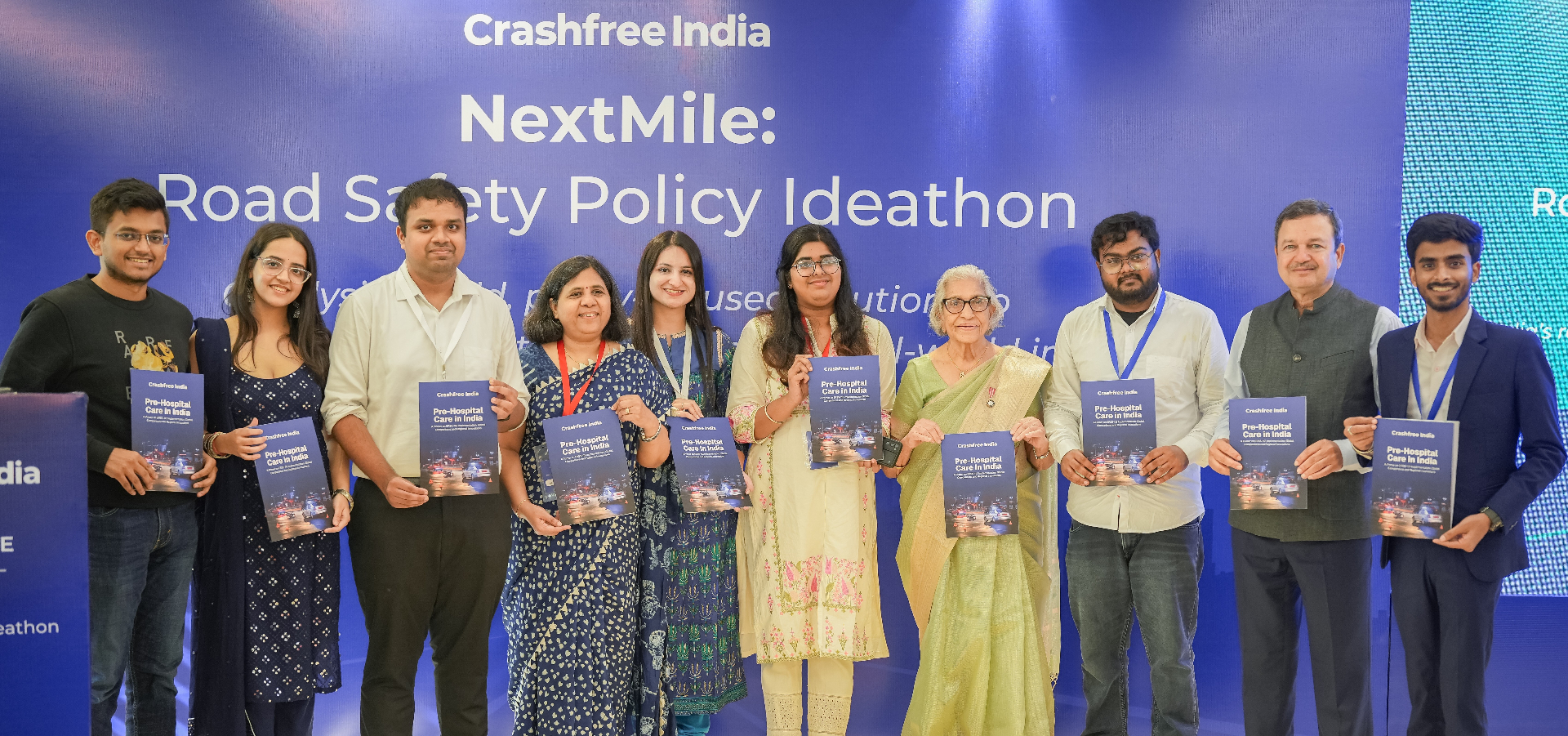
Our first primer on pre-hospital emergency care launched on 28 September at the India Habitat Centre — translating ten years of trauma-care evidence into a usable playbook.
Why a primer now
Crashfree India launched its first primer on pre-hospital emergency care — “Pre-Hospital Care in India: A Primer on ERSS-112 Implementation, Global Comparisons and Regional Innovations” — on 28 September 2025 at the India Habitat Centre, New Delhi. The launch brought together policy experts, government representatives, civic organisations and leading medical professionals to reflect on India's emergency response systems and set the stage for a wider national study and field surveys on post-crash care.
The primer serves as a foundation-setting document that highlights systemic challenges in pre-hospital care and serves as a segue into a detailed primary assessment of pre-hospital care and ERSS-112 implementation to be conducted by Crashfree India.
Key insights
- Scale of the problemIn 2023, India reported 4,80,583 road accidents and 1,72,890 fatalities, with many deaths occurring before victims reach hospitals — nearly 30% of trauma patients die en route to definitive care (Mishra et al., 2025).
- Infrastructure exists, but outcomes lagERSS-112 is operational across all 36 states and UTs with GPS-enabled dispatch, yet on core highways the ambulance arrival time at the scene is 25–35 minutes.
- Golden Hour, redefinedUniversal Golden Hour benchmarks may not reflect India's trauma realities — infrastructure and geography demand adapted timeframes for optimal outcomes.
- Global benchmark gapInternational systems achieve complete call-to-hospital delivery within 60 minutes; Indian highway episodes total 55–75 minutes before definitive intervention.
The primer calls for a citizen-centric “Chain of Survival” built on evidence and measurable outcomes:
- National performance standardsCall-to-arrival times, disaggregated by urban and rural contexts.
- AML + interoperable CADAdvanced Mobile Location + Computer-Aided Dispatch for accurate, real-time allocation.
- National trauma registryUnique patient IDs to track care from crash site through rehabilitation.
- Independent auditingOf 112 systems with transparent public reporting, integrated with injury severity.
- Bystander trainingCPR, hemorrhage control and trauma care — up to 70% of patients are still transported by family or lay responders.
Voices at the launch
“This launch marks the beginning of a national effort. The primer is meant to highlight the gaps, align stakeholders and pave the way for robust surveys and pilot studies on pre- and post-crash care.”
“In our country, even 6 or 12 hours can be considered golden hours. We need to change that definition and revise it geographically, especially by terrain.”
“Given that post-crash transport in India consists majorly of bystanders and police-driven vehicles, with very few ambulances, this primer highlights how vital timely intervention is. Contextual awareness must be integrated with functional solutions to ensure every trauma patient receives the best possible care.”
How to use it
Medical colleges can plug it into their emergency rotation. State health departments can adopt it as a baseline EMS module. NGOs and corporate first-aid programmes can lift its decision trees directly. The primer is a starting point — not a conclusion. It frames the evidence, identifies where the chain breaks, and invites wider national research and collaboration to strengthen both pre-hospital and post-crash care systems.
Crashfree India will soon initiate a detailed national study and invites lawyers, authorities, civic organisations and medical experts to collaborate. Reach the lead author at kesar.kanjhlia@crashfreeindia.org.
Bring the primer to your hospital
Free, open-access and ready to plug into state-level EMS training modules.
Share this story
India's first integrated primer on pre-hospital trauma care, co-authored with AIIMS Trauma Centre.