
Why Surjit Chowk Must Not Remain a Site of Accidents Waiting to Happen
Team Tangerine walked Rupnagar's Surjit Chowk and uncovered the design and enforcement gaps that keep this junction stuck in a loop of preventable crashes.
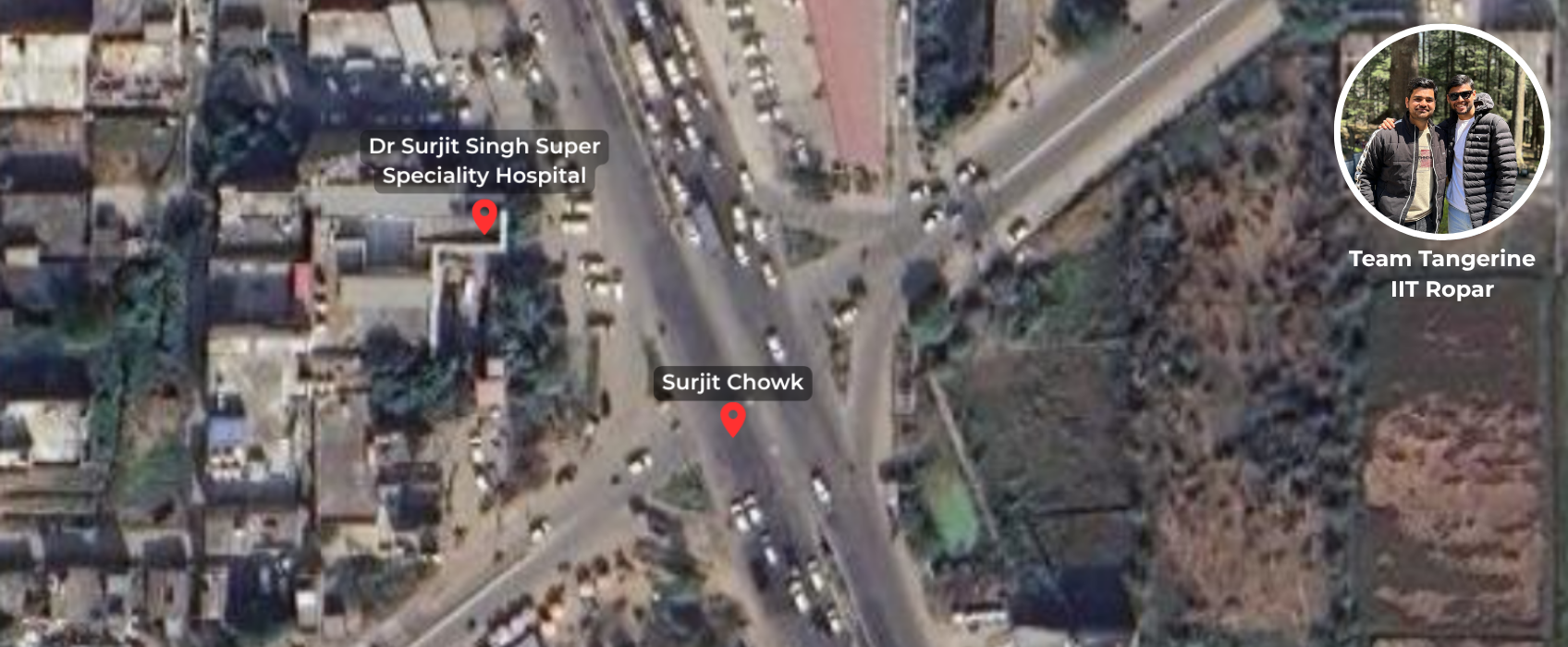
The site
If you've ever crossed Surjit Chowk in Rupnagar, you know the drill. Ambulances rush to Dr. Surjit Hospital, trucks roll through from the bypass, vendors spill onto the road, and pedestrians try their luck between gaps in traffic. When the signal fails — which it often does — the entire junction turns into chaos.
Locals say minor crashes happen every 10–15 days, often involving trucks, buses or two-wheelers. To passersby these look like near-misses, but for shopkeepers and residents they are part of a grim pattern: “this is an accident waiting to happen, every single day.”
What locals already knew
When Team Tangerine (Project Rakshak) chose this site, they knew it wasn't about proving whether the junction was unsafe — that was already obvious to residents. First-hand accounts and conversations with locals revealed the same story: overspeeding, red-light jumping and collisions stitched into the daily rhythm of this junction.
“Signals work one day, then suddenly stop.”
Shopkeepers also pointed to near-misses that happen almost daily, while commuters spoke of the risks children face trying to cross during school hours.
Through live traffic observation and a structured road safety audit, Team Tangerine found that safety at Surjit Chowk often came down to guesswork. Even the zebra crossing adds to the confusion — painted 40 metres before the signal, it tricks drivers into ignoring it altogether. Encroached medians and roadside stalls squeeze space, while dim streetlights leave both drivers and pedestrians guessing after dark. For a hospital-adjacent junction, such lapses are not minor inconveniences — they are threats to lives in critical moments.
- Three unmarked mergesDrivers improvise their right-of-way every cycle.
- No pedestrian phasePedestrians cross between vehicle gaps, against vehicle speed.
- Misplaced zebra crossingPainted 40 m before the signal — drivers ignore it.
- Encroached mediansRoadside stalls squeeze the available carriageway.
- Faded signageStop and yield boards are visually absent at night.
- Dim street lightingSpeeding trucks tear through an under-lit junction at night.
“If daytime chaos wasn't enough, nights bring another layer of risk — speeding trucks and cars tear through an unsupervised junction, with signals often failing and streetlights too dim to guide the way.”
From evidence to action
Team Tangerine's effort stands out because they pair documentation with direction. Their immediate recommendations — repairing signals, repainting crossings and ensuring an enforcement presence — are low-cost and high-impact. Their longer-term vision includes smart signal systems, speed-calming measures and proper pedestrian facilities to future-proof the junction.
- Repaint markingsLane lines, stop bars and zebra crossings in reflective paint.
- Signal phasingAdd a dedicated pedestrian phase to the existing controller.
- BollardsChannelise the three merges into ordered flow.
- LightingTwo pole-mounted LEDs to recover night visibility.
- Enforcement presenceA scheduled traffic warden to deter red-light jumping.
- Smart signalsSensor-driven phasing for the medium-term.
“I have called for ambulances from this corner more times than I have celebrated birthdays.”
The blog is not meant to gather dust on a shelf. It is a call to action. The next ambulance at this crossing should not gamble with malfunctioning lights. The next family should not hesitate at the zebra crossing, wondering if vehicles will stop. Change must start here, and it must start now. Surjit Chowk doesn't need to be remembered as a site of crashes — with collective urgency, it can become an example of how everyday fixes save lives.
One audit, six fixes
Surjit Chowk's risk is not mysterious. It is documented. It is fixable.
Share this story
A Project Rakshak audit of Rupnagar's Surjit Chowk and the interventions it demands.